Breast Cancer Awareness: Building a Lifetime Habit
Pink October is a reminder to build a lifelong habit of breast self-awareness. Learn the Touch Look Check approach, the UAE breast cancer screening recommendations by age, and what changes if you are at higher risk.

Breast Cancer Awareness Month: Pink October and Beyond
Breast Cancer Awareness Month
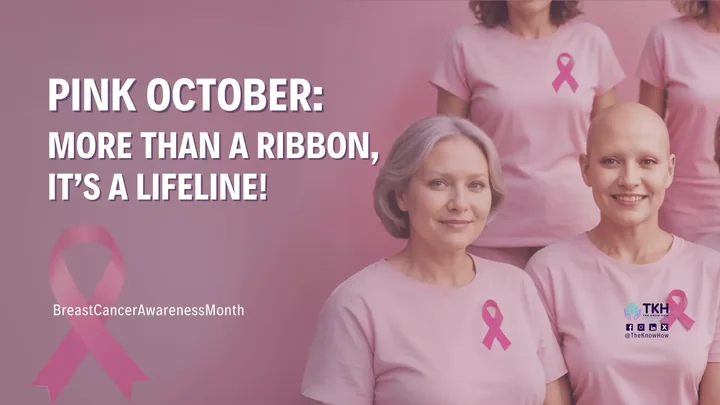
Observed every October, this awareness campaign began in 1985 in the United States. Since then, it has grown into a global movement symbolized by the pink ribbon. Its core goals are to promote regular screening, educate people about individual risk factors, support those living with breast cancer, and raise vital funds for medical research.
In “Pink October,” there are also specific dates designed to raise awareness of specific groups within the breast cancer community.
Metastatic Breast Cancer Awareness Day
This special day, observed every October 13, is dedicated to people living with breast cancer that has spread beyond the breast to other parts of the body. Although metastatic breast cancer is generally not considered curable at present, advances in treatment have made it possible in some cases to shrink or eliminate metastases and maintain a stable condition, often without pain or significant symptoms, for many years.
The day also serves as a reminder that people can do all the right things, breast cancer screenings and all the recommended treatments for early-stage breast cancer, and still have cancer spread to other parts of the body. As affected patients summarize, “Being stage IV during Breast Cancer Awareness Month sucks. All the messaging about ‘if you catch it early, you'll be fine' is simply not always true.”
Men’s Breast Cancer Awareness Week
Although breast cancer is much more common in women, it also affects men. Lack of awareness and stigma can create barriers to detection and care for men, transgender men, and nonbinary people. Therefore, in 2021, former U.S. President Joe Biden designated October 17 to 23 as Men’s Breast Cancer Awareness Week.
Touch - Look - Check: A Simple Habit for Life
One of the most powerful steps anyone can take is getting to know their own breasts or chest area. This practice, known as breast self-awareness, ensures you can notice what is normal for your body and spot changes early.
Developed by the charity Breast Cancer Now, the "Touch Look Check" (TLC) approach makes this process straightforward and accessible to everyone, requiring no special medical training.
1. Touch
- How: Gently feel your entire breast and chest area using the flats of your fingers or a flat hand. Ensure you cover the whole area, moving all the way up to your collarbone and deep into your armpits.
- What to touch for: Check whether you touch anything new or unusual, such as a distinct lump, localized swelling, unusual thickening of the tissue, or puckered skin.
2. Look
- How: Stand in front of a mirror and look at your breasts in a few different positions: with your arms resting by your sides, with your hands firmly on your hips, and with your arms raised high above your head.
- What to look for: Check for any changes in the shape or overall size of either breast. Scan the skin for redness, inflammation, puckering, or dimpling (resembling an orange peel). Pay close attention to your nipples, noting if one has recently pulled inward or if there is any unusual discharge.
3. Check
- How: Compare what you see and feel against what is normal for you.
- What to check for: Ask yourself if the change is new, unusual, or only appearing on one side. If you find anything that feels or looks different from your usual baseline, book an appointment to have it checked by a doctor promptly.
For individuals who menstruate, the ideal time for self-examination is 6 to 10 days after the first day of your period, when breast tissue is at its softest.
Rules of Breast Cancer Screening in the UAE
In the United Arab Emirates (UAE), health authorities such as the Ministry of Health and Prevention (MoHAP) and the Abu Dhabi Public Health Centre (ADPHC) maintain clear, proactively structured screening guidelines. Because regional health data indicates that women in the UAE are frequently diagnosed at an earlier age compared to Western nations, the age thresholds for routine screenings are adjusted accordingly.
Recommendations on self-examination and clinical breast exam (CBE)
Women are encouraged to start practicing monthly self-examination at the age of 20. A clinical breast exam (CBE) performed by a healthcare professional is recommended at least once every 3 years until the age of 39.
Mammography Screening
When Should I Get Screened?
For women at average risk:
- Ages 40 to 49: In the UAE, it is recommended to start having a screening mammogram (a breast X-ray) every year starting at age 40. This first exam establishes a baseline to compare with all your future charts.
- Ages 50 to 74: You should continue getting screened every 1 to 2 years. Your doctor will help you decide the exact timing based on your overall health and how dense your breast tissue is.
- Age 75 and older: Regular screening becomes a personal choice at this stage. Talk to your doctor about whether continuing mammograms is right for you, based on your current health and life expectancy.
What If I Am at Higher Risk?
Some women have a higher chance of developing breast cancer and need to start screening earlier or have tests more often. You might fall into this category if you:
- Have a family history: If your mother, sister, or daughter has had breast cancer.
- Carry specific genes: If you have tested positive for the BRCA1 or BRCA2 gene mutations.
- Had past medical treatments: If you received radiation therapy to your chest area before you turned 30 (for example, to treat lymphoma).
- Have certain breast conditions: If a past biopsy showed unusual but non-cancerous cell changes, such as atypical hyperplasia.
What this means for you: If any of these factors apply, your doctor may advise you to start annual mammograms as early as age 30. Depending on your breast density, they might also combine your mammogram with a breast ultrasound or an MRI for a clearer picture.
TheKnowHow Independent Second Opinion Service
Are you or a loved one have been diagnosed with breast cancer? You are overwhelmed or unsure about your diagnosis or planned treatment?
TheKnowHow Independent Second Opinion Service is not intended to take you away from your treating doctor but rather provide an extra level of competence.
Get an unbiased assessment from an international expert without having to travel or schedule appointments. Our impartial specialists conduct a record-based assessment of your current health state and all available treatment options, including their advantages and potential hazards.
Read more on https://theknowhow.ae/second-medical-opinion-uae/.
DISCLAIMER: This information is for general knowledge, should not be taken as medical advice, and you should consult with a healthcare provider if you have health issues.
This article is for general health information and does not replace advice from your treating physician.