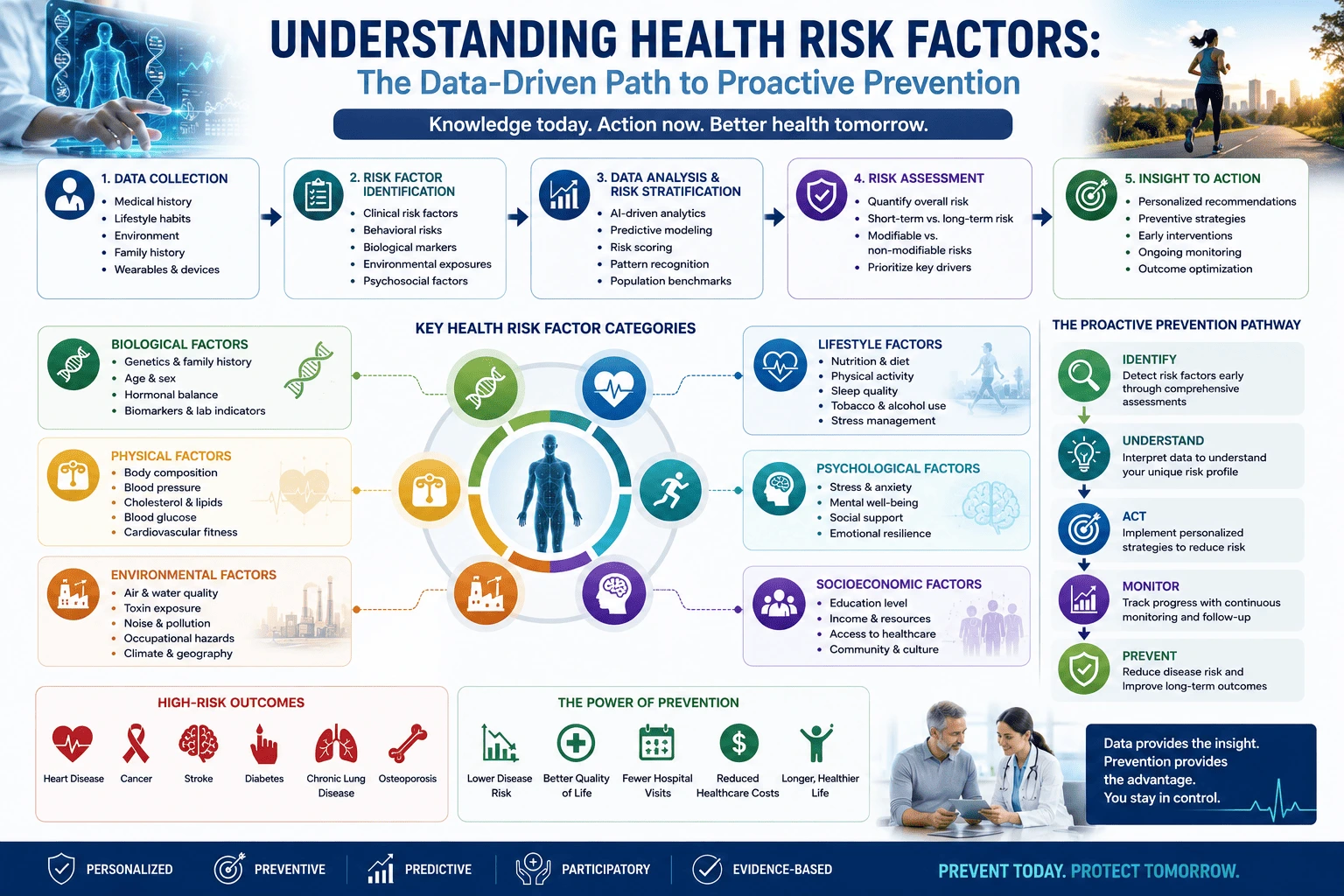
Most health advice is frustratingly vague. We are constantly bombarded with generic recommendations to “eat a balanced diet,” “exercise more,” and “manage stress.” While well-intentioned, this advice treats healthcare as a one-size-fits-all formula, ignoring the unique internal chemistry that dictates your actual health status.
To take true, proactive control of your longevity, you must move past generalized slogans and look at the hard data of health risk factors. A health risk factor is any quantifiable trait, environmental exposure, or genetic vulnerability that increases your statistical likelihood of developing a chronic condition. By systematically categorizing, measuring, and tracking these variables, you can uncover hidden vulnerabilities and fix sub-clinical issues years before they progress into a physical illness.
The Operational Divide: Modifiable vs. Non-Modifiable Risk Factors
To build an effective health optimization plan, you must draw a clear line between the biological variables you cannot change and the physiological inputs you can actively control.
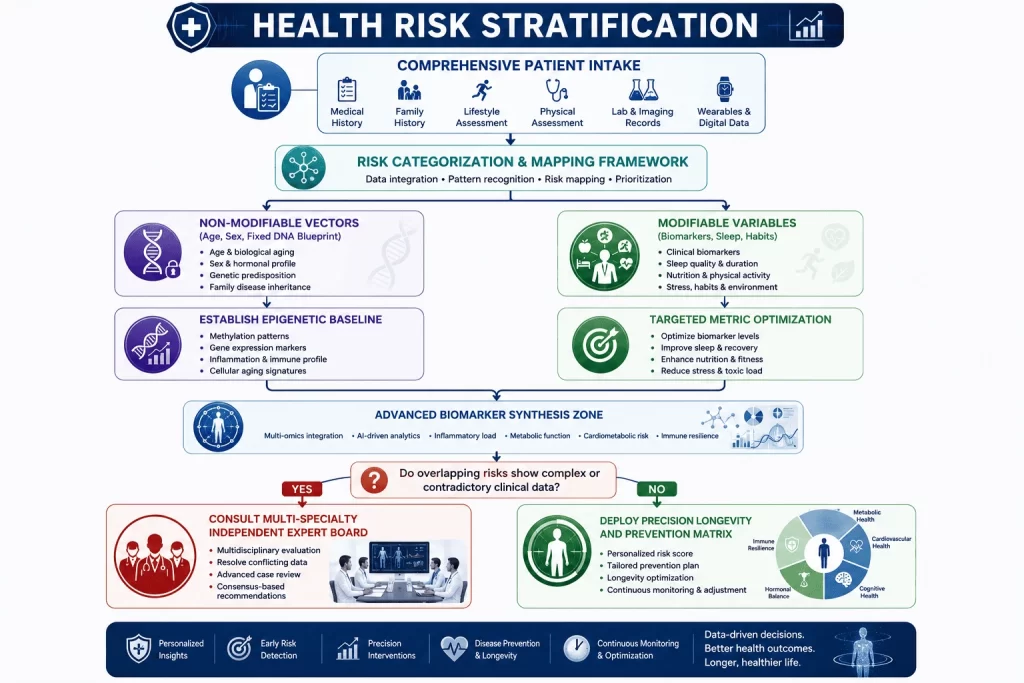
Non-Modifiable Vectors: Mapping Your Genetic Baseline
Non-modifiable risk factors are the hardwired biological constraints you are born with. These include your chronological age, biological sex, and your inherited DNA architecture. For example, if your family history carries a high prevalence of early-onset cardiovascular disease or specific cancer syndromes, your baseline risk vector is elevated from birth.
While you cannot rewrite your core DNA sequence, knowing these inherited vulnerabilities is incredibly valuable. It tells your clinical team exactly where to look, allowing them to establish a highly customized tracking schedule.
Modifiable Variables: Taking Strategic Control of Your Biology
Modifiable risk factors are the environmental, behavioral, and metabolic habits that you can actively reshape. These variables include your body composition, sleep architecture, toxin exposures (like smoking or alcohol consumption), and functional fitness levels.
The primary goal of modern preventative medicine is to optimize these modifiable inputs to keep your internal systems healthy, balancing out any inherited genetic risks.
The Compounding Multiplier: How Overlapping Risks Accelerate Disease
A common mistake in standard healthcare is looking at risk factors in complete isolation. Your body operates as an interconnected network, and when multiple sub-clinical risk factors overlap, they do not just add up—they multiply.
The Metabolic Syndrome Matrix: Interconnected Vulnerabilities
This compounding effect is clearly seen in Metabolic Syndrome—a cluster of metabolic abnormalities that occur together. A diagnosis is confirmed when an individual exhibits three or more of the following clinical metrics:
Elevated waist circumference (visceral adiposity)
Elevated fasting blood triglycerides
Reduced HDL cholesterol (“good” cholesterol)
Elevated blood pressure
Elevated fasting blood glucose
Individually, each of these conditions is a cause for concern. However, when they overlap, they cause an exponential jump in your risk of developing type 2 diabetes, stroke, and cardiovascular disease. Visceral fat cells pump out inflammatory signals that cause system-wide insulin resistance, which damages the endothelial walls of your blood vessels and accelerates plaque buildup.
Absolute Risk vs. Relative Risk: Interpreting Clinical Statistics
When evaluating your personal health metrics, it is vital to understand the difference between relative and absolute risk data:
Relative Risk: Compares the likelihood of an event occurring between two distinct groups. For instance, a study might state that a specific habit “doubles your risk” (a 100% relative increase) of a rare condition.
Absolute Risk: Measures your actual, real-world probability of experiencing an event over a specific timeframe (e.g., a 10-year window).
If your baseline absolute risk of developing that rare condition is only 1 in 10,000, doubling your relative risk only brings your actual absolute risk to 2 in 10,000—a change that remains statistically tiny. Distinguishing between these two metrics prevents unnecessary anxiety and helps you focus your attention on the risk factors that matter most to your health.
Uncovering the Silent Warners: Advanced Biomarkers for Early Risk Tracking
Standard medical checkups often fail to spot chronic diseases early because they rely on outdated blood panels. To identify health risks before they cause permanent structural damage, you need to track advanced, next-generation molecular biomarkers.
| Risk Category | Standard Clinical Marker | Next-Generation Advanced Biomarker | Preventative Optimization Value |
| Cardiovascular Risk | Total Cholesterol & LDL-C weight metrics. | Apolipoprotein B (ApoB) & Lipoprotein(a). | Counts the exact number of plaque-causing particles to catch heart disease risks early. |
| Systemic Inflammation | Standard White Blood Cell (WBC) count tracking. | High-Sensitivity C-Reactive Protein (hs-CRP). | Identifies low-grade, silent vascular inflammation that drives arterial damage. |
| Metabolic Health | Resting Fasting Blood Glucose levels. | Fasting Insulin & HOMA-IR Calculation. | Catches early-stage insulin resistance up to a decade before blood sugar spikes. |
Overriding Your DNA: How Epigenetics and Precision Medicine Reshape Your Future
One of the most empowering discoveries in modern biology is that your genetics are not your destiny. While your DNA blueprint provides the basic instructions, your daily habits and environment dictate how those instructions are executed. This is the field of epigenetics.
By integrating advanced Precision Medicine UAE screening profiles into your health journey, specialists can perform detailed genetic and epigenetic methylation audits. These advanced tests analyze how your lifestyle inputs are interacting with your genes, mapping your true biological age against your chronological calendar. This gives you a clear look at your metabolic health and allows your care team to design targeted interventions that turn off disease-driving pathways while turning on longevity-supporting genes.
Building Your Proactive Audit Plan: Steps to Quantify Your Personal Risk Vector
If you want to move past generic wellness advice and build a personalized, data-driven health strategy, follow this step-by-step approach to map your health risks:
Map Your Comprehensive Family Tree: Document the exact medical history of your first- and second-degree relatives, focusing on the early onset of cardiovascular conditions, metabolic disorders, or hereditary cancers.
Request an Advanced Biomarker Profile: Ask your doctor to run an advanced blood panel that includes ApoB, Lipoprotein(a), fasting insulin, and high-sensitivity C-reactive protein (hs-CRP).
Quantify Your Body Composition: Move past BMI and get a high-resolution DXA scan to measure your exact visceral fat distribution.
Audit Your Lifestyle Data Baseline: Use wearable devices to track your resting heart rate, heart rate variability (HRV), and deep sleep stages over a 30-day window to measure your nervous system’s stress resilience.
If your risk assessments show complex, elevated, or conflicting data across different specialties, requesting a formal Second Medical Opinion UAE connects your complete diagnostic file with leading independent specialists. This independent review helps reconcile conflicting data and ensures your preventative strategy is perfectly optimized.
Clinical Certainty: Transforming Raw Data into a Lifetime of Longevity
Understanding your health risk factors is not about living in fear of your genetics or obsessing over every minor symptom. Instead, it is about gaining clinical clarity. When you replace vague lifestyle theories with precise, personalized biomarkers, you remove the guesswork from your daily habits.
Every single data point you collect is a tool for optimization. By identifying your unique risk factors early, you can take strategic, targeted action to protect your health—transforming raw biological data into a practical roadmap for lifelong energy, vitality, and healthspan.