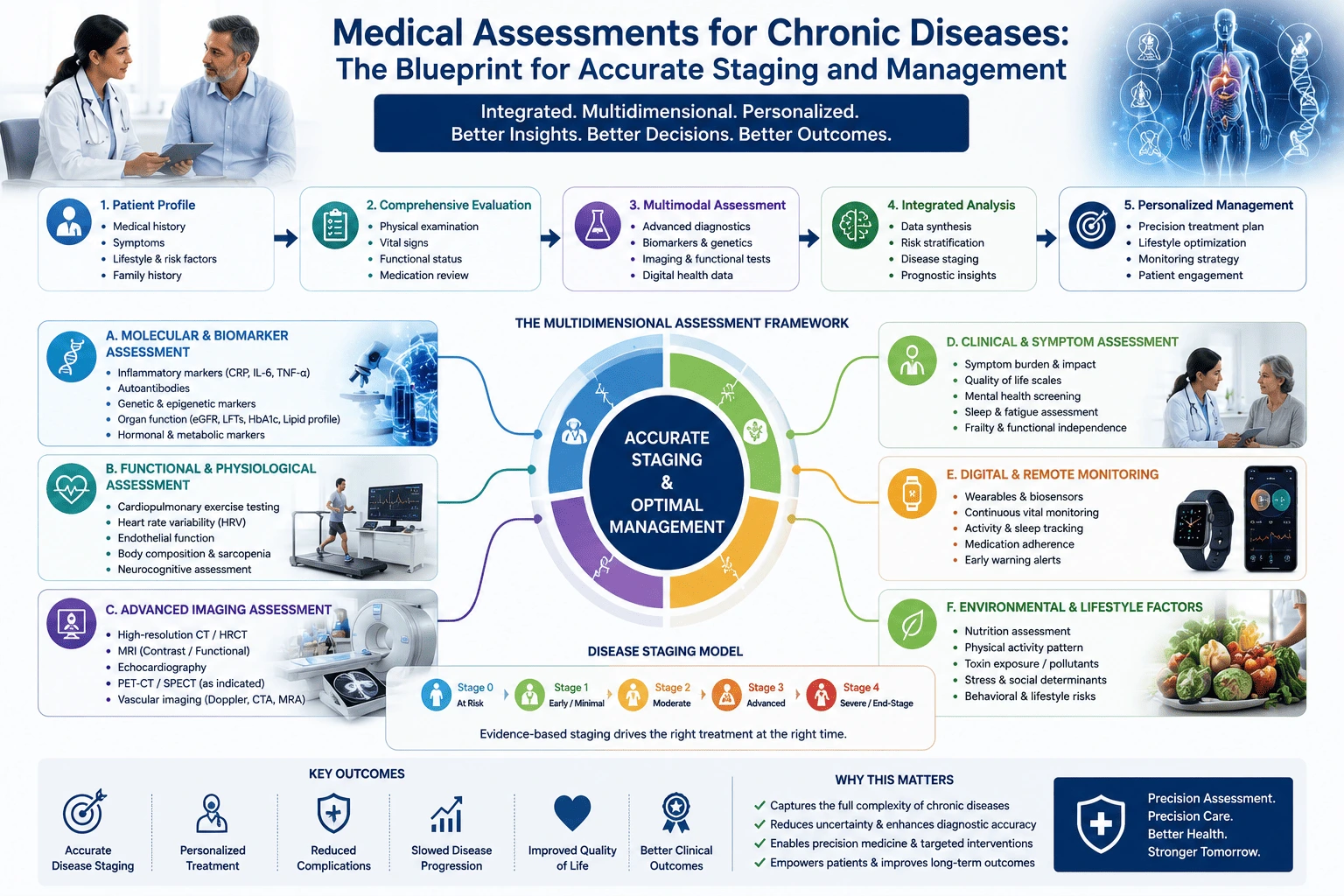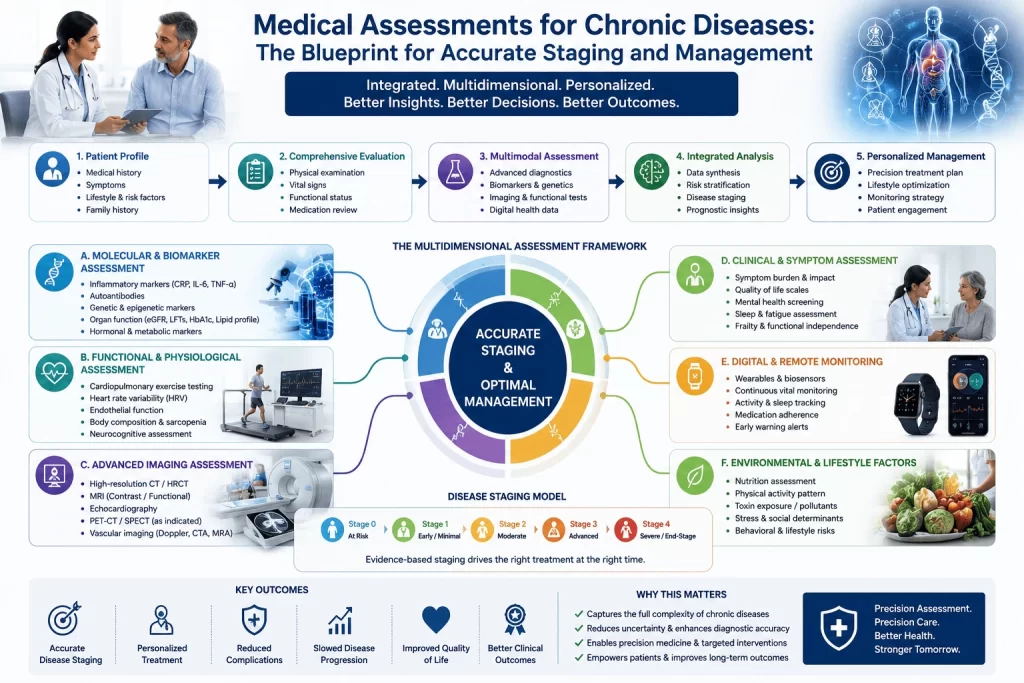
When managing a long-term condition, a standard, routine physical exam is simply not enough. Chronic illnesses—such as cardiovascular disease, metabolic disorders, neurodegeneration, and autoimmune syndromes—develop slowly over months and years, often hiding deep within your cells long before physical symptoms appear.
A comprehensive medical assessment for chronic diseases is an in-depth, multi-system diagnostic evaluation designed to map your unique physiology. Instead of just managing symptoms, these advanced assessments measure the exact stage of a condition, uncover hidden inflammation, and assess your organs’ true functional capacity. Gathering this precise data allows your medical team to build an optimized, highly personalized treatment plan to halt disease progression and protect your health.
1. The Anatomy of a Comprehensive Chronic Disease Assessment.
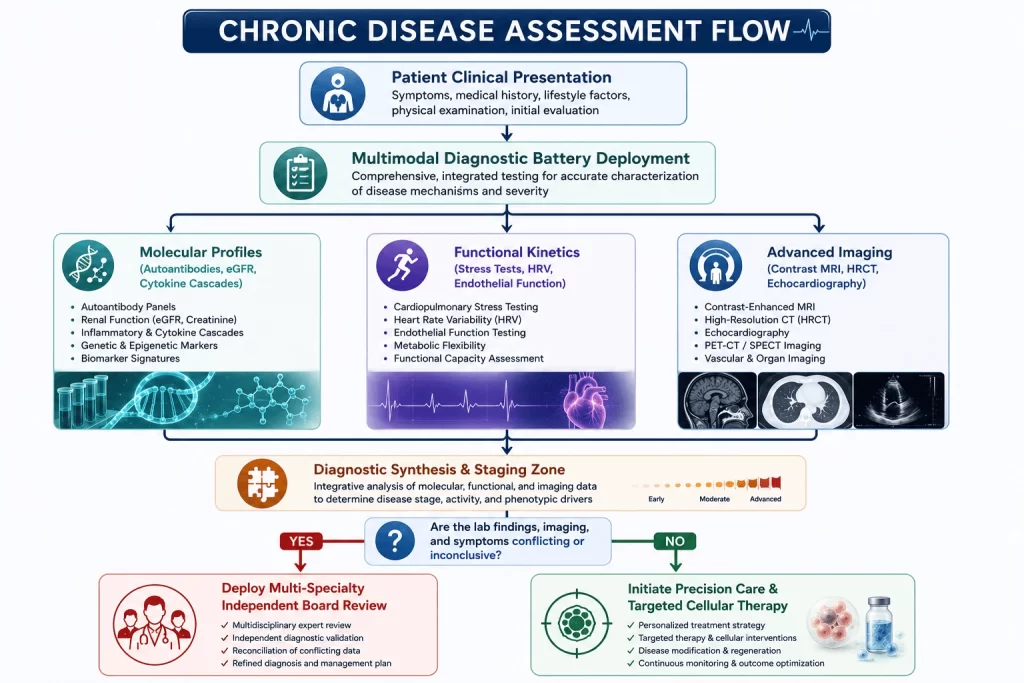
An accurate chronic disease evaluation avoids guesswork. It relies on a carefully coordinated combination of three primary diagnostic pillars to build a complete picture of your internal health.
Molecular and Biochemical Profiles: Looking Inside the Cells
Advanced blood, urine, and tissue analyses form the foundation of chronic disease monitoring. Rather than just tracking standard blood counts, specialists look at complex molecular biomarkers. This includes running detailed autoantibody panels to catch autoimmune issues early, measuring specific cytokine cascades to track systemic inflammation, and evaluating organ-specific markers like NT-proBNP for heart health or eGFR for kidney function.
Functional Kinetics and Stress Testing: Measuring Systems in Motion
Resting lab tests do not always show the whole picture; many chronic issues only reveal themselves when your body is actively working. Functional kinetics testing evaluates how your organs perform under stress. This includes cardiopulmonary exercise testing (CPET) to measure heart-lung efficiency, continuous glucose monitoring (CGM) to evaluate real-time metabolic resilience, and advanced testing to measure microvascular endothelial function (the health of your smallest blood vessels).
Structural and Advanced Diagnostic Imaging: Visualizing Internal Architecture
High-resolution imaging allows clinicians to see structural changes inside your body. By using advanced diagnostic tools—such as Contrast-Enhanced MRI, High-Resolution CT (HRCT) scans, and speckle-tracking echocardiography—specialists can identify subtle tissue changes, arterial plaque stability, and early structural remodeling long before organ function drops.
2. Resolving Diagnostic Ambiguity: The Role of Differential Diagnosis
The greatest challenge in managing chronic disease is dealing with diagnostic ambiguity. Many chronic conditions share overlapping symptoms, making accurate initial assessments absolutely vital.
The Overlap Phenomenon: Unraveling Interconnected Syndromes
Symptoms like chronic fatigue, joint pain, muscle weakness, and brain fog are common across dozens of different conditions, ranging from early-stage Type 2 diabetes and hypothyroidism to complex autoimmune disorders like lupus or rheumatoid arthritis.
A rigorous differential diagnosis matrix is used to systematically rule out competing explanations for your symptoms. By cross-referencing your physical signs with specific, highly targeted lab tests, specialists ensure your diagnosis is highly accurate, preventing you from wasting time on ineffective treatments.
Static Lab Values vs. Dynamic Biomarker Kinetics
A single out-of-range lab result is just a snapshot in time; true clinical clarity comes from tracking biomarker kinetics—the rate and direction of change in your numbers over time.
For instance, a blood sugar level that is gradually climbing within the “normal” range over two or three years reveals a pattern of progressing insulin resistance that a single, isolated look would completely miss. Modern chronic disease assessments focus heavily on these longitudinal trends to catch health risks early.
3. Core Staging Frameworks for the Most Common Chronic Conditions
To manage a condition effectively, clinicians use objective staging frameworks to map the exact progression of a disease and choose the right level of medical intervention.
| Chronic Disease Category | Essential Diagnostic Modalities | Primary Clinical Staging Metrics | Target Management Focus |
| Cardiovascular Disease | Echocardiography, Coronary CT Angiography, Advanced Lipid Arrays (ApoB). | NYHA Functional Classification, Coronary Artery Calcium (CAC) Score. | Preventing structural heart changes and stabilization of arterial plaques. |
| Metabolic Disorders | Oral Glucose Tolerance Testing (OGTT), Fasting Insulin, HOMA-IR, Glycated Hemoglobin. | Stage 1 (Insulin Resistance) to Stage 4 (Vascular & Neuropathic End-Organ Damage). | Reversing metabolic dysfunction and restoring tissue insulin sensitivity. |
| Autoimmune & Inflammatory | Antinuclear Antibodies (ANA), Rheumatoid Factor, hs-CRP, ESR, Cytokine Panels. | Disease Activity Scores (e.g., DAS28), Tissue Biopsy Histopathology. | Calming overactive immune responses and preventing permanent joint or tissue damage. |
Precision Medicine: Using Molecular Phenotyping to Tailor Chronic Care
The modern era of chronic disease management has moved past generic, standardized protocols. Through the integration of Precision Medicine UAE frameworks, patients can now access deep molecular phenotyping, advanced genetic sequencing, and multi-omic metabolic analysis.
Instead of categorizing diseases into broad, generic buckets, precision medicine looks at the exact cellular mechanisms driving your specific condition. This advanced approach allows clinicians to predict how you will respond to specific therapies, select medications that perfectly match your genetic profile, and design cellular-level interventions that can slow down or even stop chronic disease progression.
Navigating Contradictory Results: How to Secure Diagnostic Certainty
It is incredibly common for patients dealing with complex, multi-system chronic symptoms to receive conflicting medical test results from different clinics. One scan might indicate a structural issue, while a blood panel from another facility suggests everything is perfectly normal. This kind of diagnostic confusion can stall your recovery and lead to fragmented, ineffective care.
When facing complex, unyielding, or ambiguous clinical data, seeking an independent Second Medical Opinion UAE is a crucial step to regain control of your health. This process brings together your complete medical history, lab results, and imaging for a comprehensive review by a multi-specialty board of independent experts. This high-level review reconciles conflicting data, eliminates diagnostic blind spots, and gives you the absolute clinical certainty you need to move forward with confidence.
Proactive Clinical Tracking: Turning Diagnostic Data into Long-Term Vitality
A high-quality chronic disease assessment is not a one-time event; it is a powerful, ongoing strategy for long-term health optimization. By regularly collecting precise, objective biomarker data, you shift from being a passive observer of a disease to an active manager of your own biology.
Every structured medical assessment gives you the deep insights needed to fine-tune your treatment plan, adjust your lifestyle habits, and track your recovery at a cellular level. Ultimately, transforming raw clinical data into a personalized, proactive roadmap gives you the power to protect your organs, optimize your daily energy, and enjoy a long, vibrant healthspan.