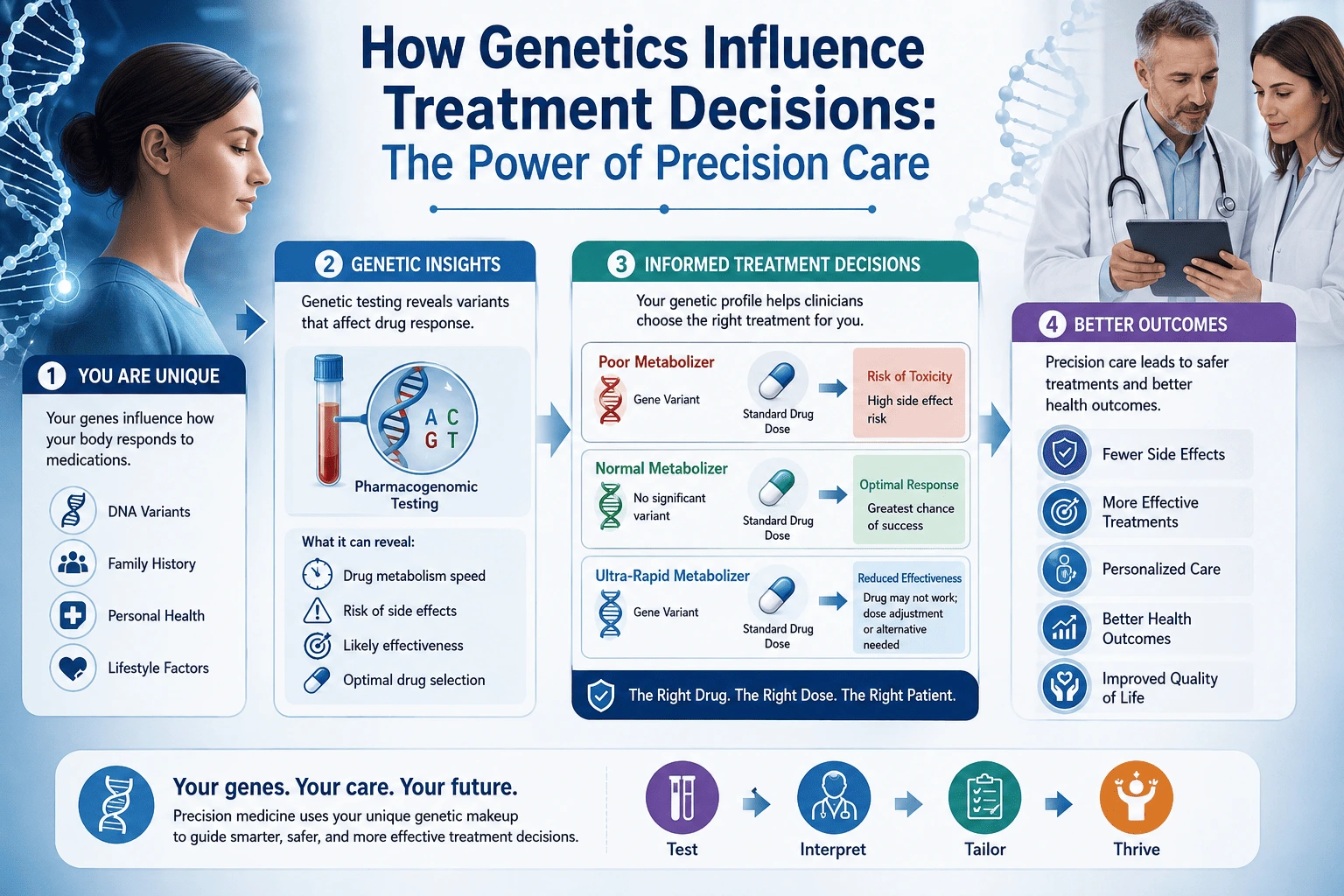
For generations, clinical prescribing followed a standardized, population-wide rule: if a medication successfully lowered blood pressure, reduced tumor size, or stabilized mood for 60% of a clinical trial group, it was treated as the default therapy for everyone. If a specific patient failed to improve or suffered severe side effects, it was often written off as an unavoidable statistical anomaly. Today, modern genomic science reveals exactly why those anomalies happen. The answer is written directly inside our DNA.
Your genetic blueprint dictates how your body absorbs, processes, and eliminates virtually every pharmaceutical compound in existence. Understanding how genetics influence treatment decisions is transforming modern medical care. By replacing guesswork with precise data, your unique genetic markers allow doctors to select the ideal medication at the correct dosage on the very first attempt.
The Core Science: What is Pharmacogenomics?
At the center of this medical revolution is a specialized field known as pharmacogenomics—the study of how an individual’s inherited genetic variations affect their response to specific medications.
The Liver Enzyme Engine: Fast vs. Slow Metabolizers
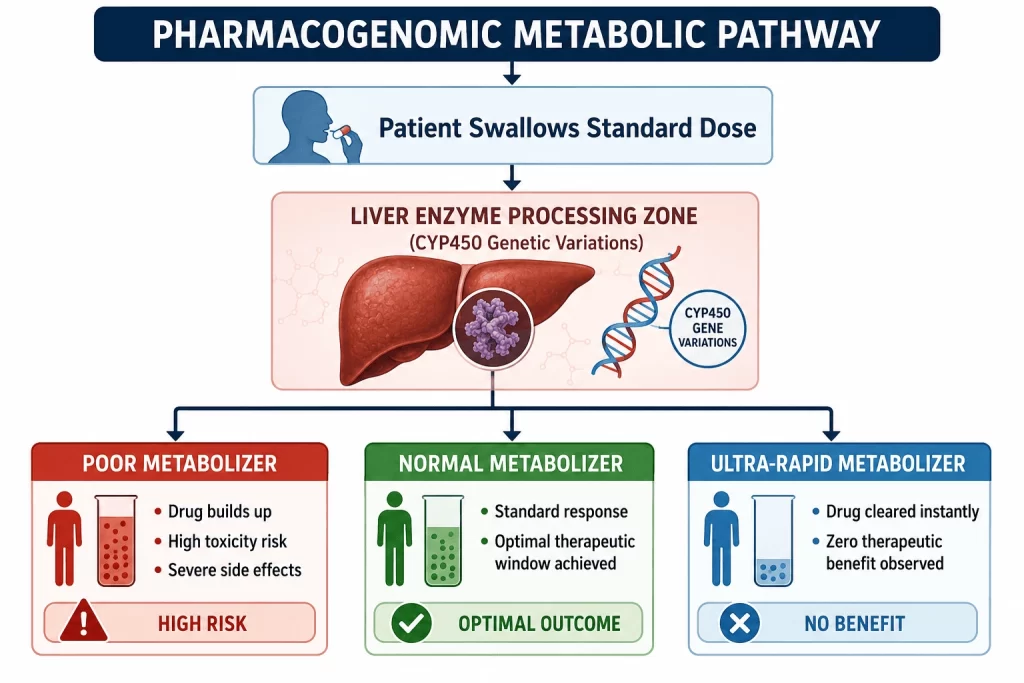
When you take a pill, your liver relies on a specific family of enzymes—primarily the cytochrome P450 (CYP450) system—to break down the drug and send it into your bloodstream. Variations in your genetic code determine how active these enzymes are, categorizing your body into distinct metabolic profiles:
Poor Metabolizers: Your liver processes a specific drug incredibly slowly. As a result, standard doses build up in your system, rapidly reaching toxic concentrations that trigger severe side effects.
Ultra-Rapid Metabolizers: Your liver clears the medication almost instantly, before it ever has a chance to work. To you, a standard dose feels like taking a completely empty placebo.
Preventing the Silent Threat of Adverse Drug Reactions
Adverse drug reactions (ADRs) are a leading cause of prolonged hospital stays and preventable medical complications globally. By running a simple, non-invasive genetic profile before writing a prescription, physicians can spot these hidden metabolic red flags early. This allows them to proactively adjust dosages or select safer alternative therapies entirely.
Revolutionizing Oncology: Targeted Therapies and Tumor Sequencing
Nowhere is the impact of genetics on treatment decisions more apparent than in modern oncology. Historically, cancer therapies were chosen based solely on where the disease originated in the body, treating all lung, breast, or colon cancers with identical, aggressive chemotherapies.
Shifting from Location-Based to Mutation-Based Cancer Care
Today, advanced oncology analyzes the genetic mutations driving the tumor itself. By utilizing comprehensive Precision Medicine UAE screening panels, oncologists can map a tumor’s unique genetic profile. This allows them to bypass generic options and select highly advanced, target-specific biological therapies designed to lock onto and destroy mutated cancer cells while leaving healthy surrounding tissue completely unharmed.
Spacing Out the Need for Traditional Toxic Chemotherapy
For conditions like early-stage, hormone-receptor-positive breast cancer, genetic tests like Oncotype DX analyze the activity of specific genes within the tumor tissue. The resulting score tells doctors exactly how likely the cancer is to return. For thousands of patients with low recurrence scores, this genetic clarity reveals that traditional, highly toxic chemotherapy provides no clinical benefit, allowing them to safely skip it and rely on targeted hormone therapies instead.
Psychiatry and Cardiology: Ending the Dangerous "Trial-and-Error" Cycle
Beyond cancer care, genetic testing is quietly eliminating the frustrating, often dangerous trial-and-error prescribing cycles that have long complicated fields like mental health and cardiology.
Mental Health Care and Genetic Balancing
In psychiatry, finding an effective medication for conditions like major depression or severe anxiety can traditionally take months of experimental prescribing. Genetic screening tests evaluate a patient’s neurotransmitter receptor variants and CYP450 liver enzymes. This data guides clinicians directly toward the specific classes of antidepressants or mood stabilizers that align with the patient’s biology, significantly reducing the time it takes to find therapeutic relief.
Cardiovascular Safety and Antiplatelet Therapies
In cardiology, antiplatelet medications like clopidogrel (Plavix) are routinely prescribed to prevent blood clots after a heart attack or stent placement. However, roughly 30% of the population carries a specific genetic variant in the CYP2C19 gene that prevents their body from converting this drug into its active form. If a cardiologist prescribes clopidogrel to a patient with this variant without checking their genetics, the patient remains completely unprotected from suffering a secondary, catastrophic clotting event.
Practical Integration: Accessing Advanced Molecular Architecture
The historical model of relying on generic population averages is no longer the gold standard of care. If you are currently navigating an illness that is non-responsive to therapy, or if you want to understand your inherent biological risks, your path forward relies on securing deep molecular data.
| Medical Practice Discipline | Old Paradigm (Standard Medicine) | New Paradigm (Genomic-Driven Medicine) | Primary Clinical Benefit |
| Oncological Care Selection | Choosing chemotherapy based entirely on the tissue organ of origin. | Mapping the tumor’s unique DNA to identify targetable mutations. | High-precision destruction of cancer cells with minimal systemic toxicity. |
| Cardiovascular Risk Planning | Using fixed standard dosages for blood thinners and statin therapies. | Testing genetic enzyme paths (e.g., CYP2C19) before prescribing. | Prevention of secondary strokes or hidden toxicity-induced muscle damage. |
| Neurological & Psychiatric Care | Rotating through different mental health medications over months. | Profiling serotonin and dopamine receptor gene variations. | Rapid stabilization by targeting the body’s natural neurological pathways. |
Redefining Chronic Illness Tracking Through Genomic Insights
When standard therapies fail to deliver results, it is a clear indicator that your underlying condition may be driven by atypical genetic factors that are invisible to routine laboratory exams.
If you are stuck in a cycle of unresolved symptoms or experiencing unexpected drug reactions, seeking an independent, data-driven Second Medical Opinion UAE can break the deadlock. Reviewing your case through a genomic lens allows independent specialists to re-verify your foundational diagnosis. This ensures your treatment plan is matched directly to your molecular biology rather than generic, population-wide averages.
The Clinical Horizon: Taking Control of Your Biological Trajectory
Integrating genetics into treatment decisions marks a definitive shift in modern healthcare: we are moving away from reactive damage control and entering an era of proactive, tailored prevention. Your DNA is no longer a hidden mystery; it is an accessible, highly practical roadmap.
By uncovering your body’s unique metabolic preferences and cellular vulnerabilities, genomic medicine takes the guesswork out of healthcare. Embracing this data-driven strategy ensures that your medical care remains as unique, adaptive, and precise as your own DNA.